Compose the pieces.
Read the inputs, process the data, and call the tools needed to produce the output.
 VARIANT-1
Release status
VARIANT-1
Release status
THE WORKSPACE / WINDOWS
VARIANT-1 gives your model a persistent Python environment and tools for files, browsing, and desktop work. Ask for a result, inspect what it produces, and keep going in the same chat.
01 / THE WORKSPACE
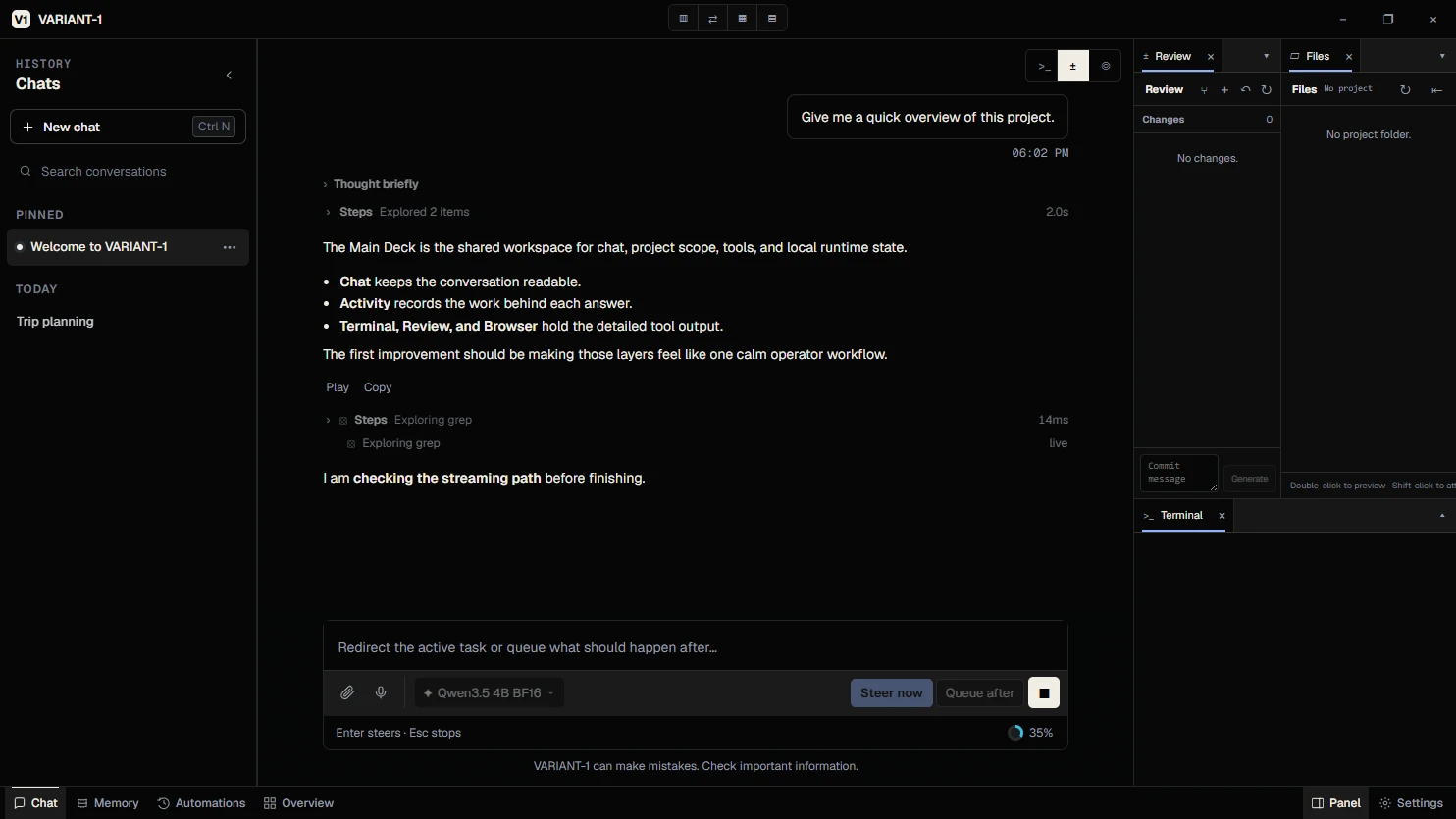
Bring a project, a set of documents, or a task in another application. Your model can use code and tools to work through it, while the chat, files, browser, terminal, and review panes keep the work in view.
Explore example workflowsAsk → work → review
Your model chooses the steps. Python and connected tools give it ways to carry them out.
MAIN DECK / DEVELOPMENT INTERFACE
02 / WORKING STATE
Clean a dataset, then ask for a different comparison. The model can reuse the data and helper functions from earlier calls while the chat’s Python runtime stays alive.
A restart or lost runtime can clear live state. Optional checkpoints preserve supported values when enabled; saved files and approved memory are stored separately.
See what persists
The data and helper are still in Python. The next call can use them directly.

Checkpointing and restoration are off by default. After a restart, check the saved files and any restored values before continuing.
03 / COMPOSABLE METHODS
Your model can turn a repeated step into a Python helper and combine it with other tools. The code stays available to read, change, and use again.
Enable mutation to let the model propose and activate revised tool methods within the chat. These are changes to executable code; the model’s weights stay the same.
Read about tools and mutationMutation is off by default. Turning it off stops new changes, but does not remove changes already active in the chat.

Read the inputs, process the data, and call the tools needed to produce the output.
Give a repeated operation a name and clear inputs so it can be reused and adjusted.
Open the file, compare the values, or inspect the application. Use the result to decide what needs changing.
04 / MODEL CHOICE
Use a supported local model, connect an API key, or sign in through a provider account. Choose the model for your task and keep the same place to work.

01 / LOCAL
Run a supported model locally with your own model files and hardware.
Local models
02 / API
Use your API key or a supported custom endpoint. Your provider handles model usage and billing.
API connections
03 / ACCOUNT
Sign in through a supported provider connection. Your account needs the access or subscription that provider requires.
Account connections